

Ordinary Time

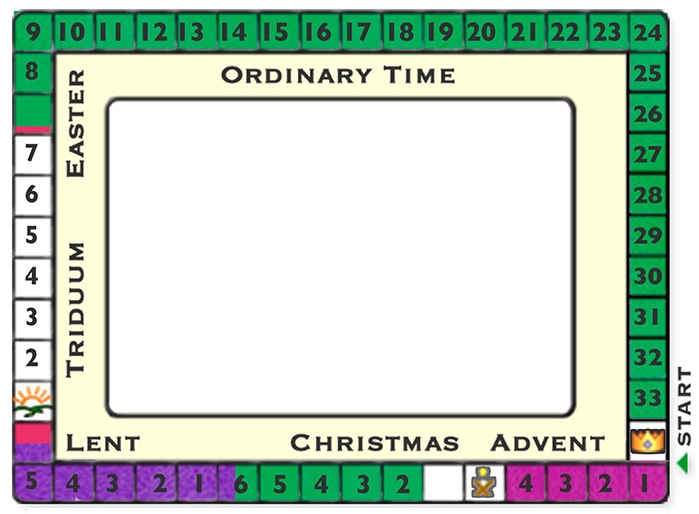
The term "Ordinary Time" may be misleading. In the context of the liturgical year the term "ordinary" does not mean "usual or average." Ordinary here means "ordinal," or "counted." Ordinary Time is the part of the year that lies between Christmas and Lent and between Easter and Advent. In Ordinary Time, the Church celebrates the mystery of Christ not in one specific aspect but in all its aspects. The readings during the liturgies of Ordinary Time help to instruct us on how to live out our Christian faith in our daily lives.
For Ordinary Time, readings for the Liturgy of the Word have been chosen for thirty-four Sundays and the weeks following them. However, some years have only thirty-three weeks of Ordinary Time. Further, since the Christmas season ends on a Sunday with the Baptism of the Lord, and the Easter season ends with Pentecost Sunday, two weeks in Ordinary Time do not have a corresponding Sunday. In addition, some Sundays of Ordinary Time are superceded by a solemnity that coincides with a Sunday, e.g., The Most Holy Trinity or Christ the King, the last Sunday of the Liturgical Year.
Ordinary Time in the Church's year occurs in two sections. The first part begins on the Monday following the Christmas season, which ends with the Feast of the Baptism of the Lord on the Sunday following January 6. It lasts through the Tuesday before Ash Wednesday, the beginning of the Lenten season. Ordinary Time resumes after the Easter season, on the Monday after Pentecost, and continues until evening prayer on the Saturday before the First Sunday of Advent. The Sunday that follows the Feast of the Baptism of the Lord is the Second Sunday in Ordinary Time. The remaining Sundays are numbered consecutively up to the Sunday preceding the beginning of Lent.
When the readings for Ordinary Time resume after Pentecost Sunday, the selection depends on the length of the season that year. When there are thirty-four Sundays in Ordinary Time, the week to be used is the one that immediately follows the last week used before Lent. When Ordinary Time has thirty-three Sundays, the week that would consecutively follow after Pentecost is omitted. This is to assure that the texts assigned to the last two weeks of Ordinary Time about the coming of God's kingdom are proclaimed.
Themes in Prayer and Scripture
During the Liturgical Year, the Scripture readings for seasons of Lent, Easter, Advent, and Christmas have prominent themes. During Ordinary Time the readings are not chosen according to a theme. Rather, they present in a continuous fashion the life and work of Jesus Christ as proclaimed in the Gospels of either Matthew, Mark, or Luke. John's Gospel is read principally during the seasons of Christmas and Easter.
The Gospel Readings
During the Christmas season, the Gospels recount the birth and early life of Jesus. On the Second Sunday
of Ordinary Time, the Gospels begins to speak about the ministry of Jesus though the text about the
wedding feast at Cana and two other passages from the Gospel of John. Then, with the Third Sunday, the
life and preaching of Jesus unfold in each of the Gospels.
The Old Testament Readings
The readings from the Old Testament were chosen to correspond to the Gospel passages and to bring out
the unity between the Old and the New Testaments. The selections were made so that many of the principal
pages of the Old Testament would be read on Sundays. The readings are arranged in a logical order,
according to what the Gospel Reading requires.
The Readings from the Apostles
During Ordinary Time, the Letters of Paul and James are read in a sequential manner. (The Letters of
Peter and John are read during the Easter and Christmas seasons.) Because of the length of the First Letter to the Corinthians
and the diverse issues it addresses, the selections from it are read at the
beginning of Ordinary Time over the three years of the Lectionary cycle. The Letter to the Hebrews is
divided into two parts. The first part is read in year B and the second in Year C.
The feast of Christ the King is the last Sunday of Ordinary Time and of the Liturgical Year.
The Liturgical Color
The liturgical color for Ordinary Time is green, a sign of hope.
A Symbol for Ordinary Time
The Chi Rho is a Christian symbol that dates from the early Church. It is comprised of the first two letters of the Greek word for Messiah, Christos. This abbreviation became a symbol representing Jesus Christ.